Open Today DUBAI: 10am - 6pm | RAMALLAH: 10am - 6pm
Open Today DUBAI: 10am - 6pm | RAMALLAH: 10am - 6pm
1 August – 1 October, 2026
1030 +
Khaled Hourani
Location: Ramallah
“These works are not about war or life as events, but about humans after the events have faded, if they do at all. It’s about an existence suspended between earth and sky, where the body remains a witness, and the shared air remains the last link between us.”
Khaled Hourani, 2026
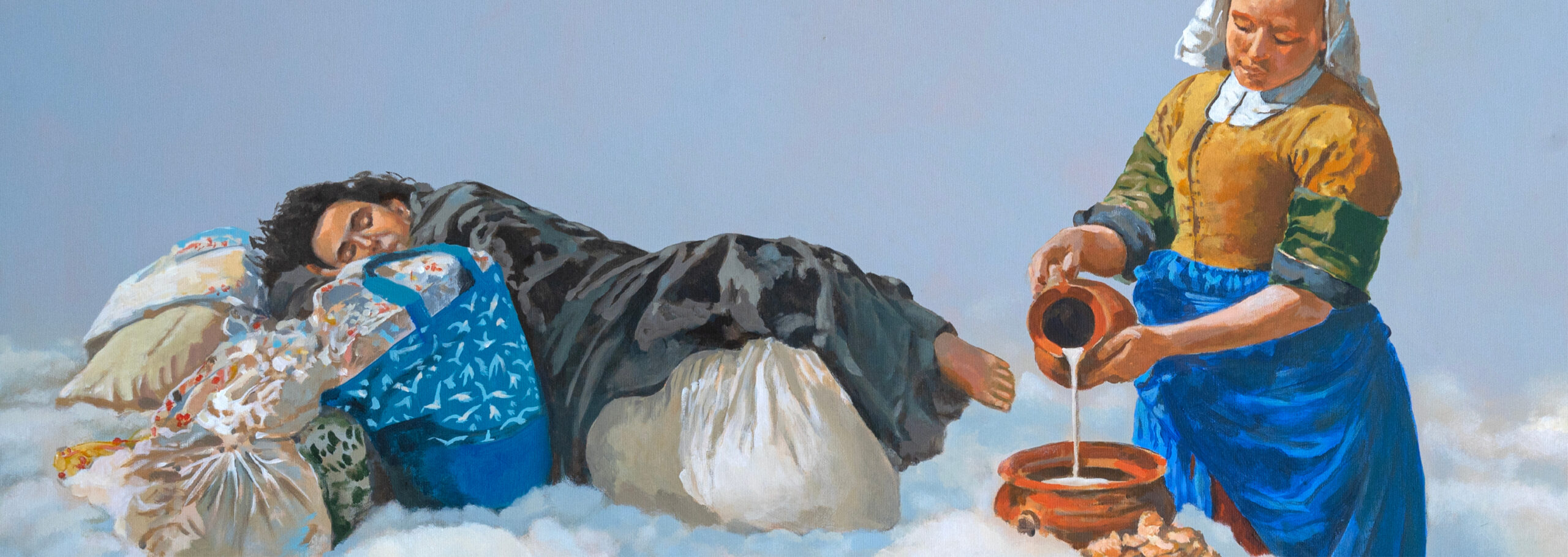
All that the earth casts off is caught by the sky. After 1030 days, images from Gaza continue to emerge from thick plumes of grey smoke, bearing remnants of things, fragments of dreams, bodies, dust, and memories. In Khaled Hourani’s works for 1030 + exhibition, that heavy smoke and the pervasive greyness so familiar to Gaza’s landscape during genocide are absent. Instead, his works are full of calm, ease, and tranquility. Serene white clouds drift across the sky announcing no weather, promising no rain, warning of no storm. They become instead a safe haven cradling weary bodies and tired souls for whom the earth, for all its vastness, has grown too narrow. Hourani’s clouds glide silently along the horizon, carrying those who found no escape from the creeping death below, offering a refuge that stands in for a geography now drowned in iron and fire by colonisers.
The poet wrote:
I wish children would be temporarily
elevated to the skies until the war ends.
Then they would return home safe,
and when their bewildered parents would ask them:
“where were you?” they would say joyfully:
“we were playing with the stars.” ¹
And so Khaled Hourani lifts the children of Gaza into the sky, holding them there until the war ends, bidding them farewell among the clouds, in all the lightness and fragility, as if the clouds were a safe haven offering refuge from the bombing and destruction, a place to search for the childhood the earth has denied them. We see some playing, others in the company of family members, or carried by their parents, sometimes struggling to walk along.
Hourani anchors his paintings in photographs from Gaza, yet strips away everything but what matters most: the people, the children, and the faces. He captures movement with precision, depicting those carrying sacks of flour, food, or bags of belongings; a father holding his child with tender care; groups of families moving from one uncertain place to the next; displaced women, worn from long journeys, sitting wearily above the clouds as if suspended between life and death. He paints the folds of garments, the subtleties of features, the uncertainty of gestures, transforming the familiar into the sacred, and the forgotten into the eternal.
In one painting, we see a martyred child, his face still full of life, lying in a coffin suspended in the sky like a cloud sweeping gently above a city razed to the ground. The indigo-blue coffin, a symbol of grief, casts its shadow on earth, steering contradictory feelings caught between weight and lightness. Hourani’s canvases become spaces of spiritual reflection, where the clouds form a transparent veil separating the earth and sky, a shore between life and death, or a hidden world parallel to our own.
He explores familiar symbols tied to the UN’s long presence in Gaza’s refugee camps, critiquing Israel’s targeting of food aid and schools, while introducing new symbols like the deadly yellow line, with its expanding cubes, redrawing the geography of loss and displacement.
In Hourani’s clouds, we see how our inner worlds are shaped by pain, and how imagination becomes a last refuge. Our souls grow fleeting as the clouds, and the sky becomes a place that embraces what the earth can no longer bear: martyrs, exhausted bodies and incomplete stories. Hourani offers us a space to dream in times of suffocation, and an alternative sky to take shelter in until the war ends.
– Words by Rana Anani
¹ The Palestinian poet Samir Atiy